
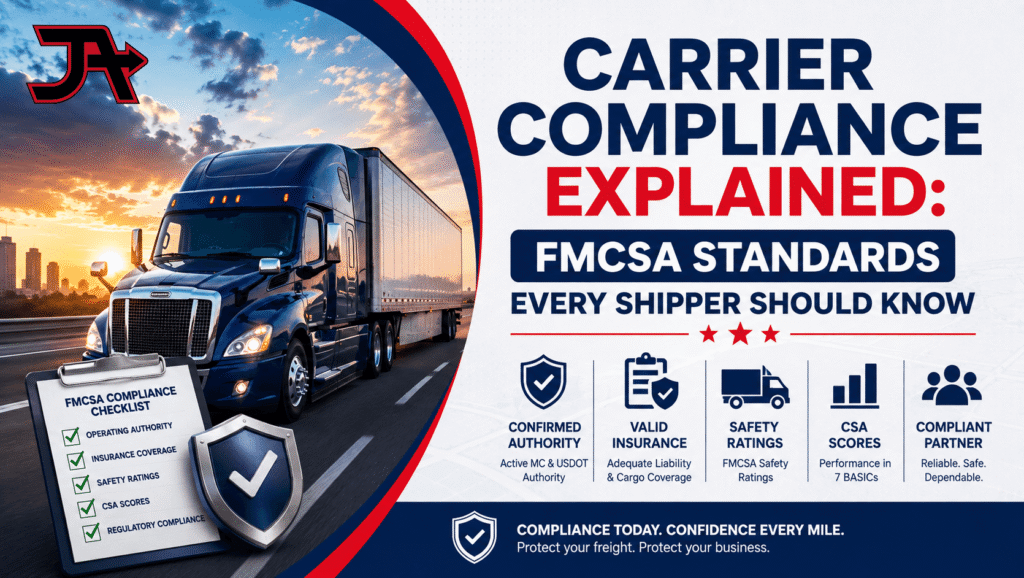
Most shippers assume carrier compliance is someone else’s problem. It feels like a background detail, a box the carrier checks before the truck ever shows up. That assumption holds up right until a load goes missing, arrives damaged, or gets delayed because the carrier that picked it up never should have been dispatched in the first place.
Compliance is not just paperwork sitting in a carrier’s file. It is the difference between freight moving on a legally authorized, insured, and safety-checked operation and freight moving on a truck with none of those things confirmed. For shippers, understanding what the Federal Motor Carrier Safety Administration actually requires, and knowing how to check it, is one of the most practical risk-reduction steps available before freight ever leaves the dock.
Here is what FMCSA compliance covers, why it belongs on a shipper’s radar and not just a carrier’s, and how to verify it before you commit a load.
What Is the FMCSA and Why Should Shippers Care?
The Federal Motor Carrier Safety Administration is the federal agency responsible for regulating commercial motor carriers and the brokers who arrange freight movement across the country. Its job is to set the operating standards that keep trucks legally authorized, properly insured, and safe on the road.
Carriers carry the direct regulatory burden. They are the ones required to hold active authority, maintain insurance, and pass safety reviews. Shippers do not answer to the FMCSA the way carriers do, but shippers absorb the consequences when a carrier fails to meet those standards. A lapsed authority, an expired insurance policy, or a poor safety history does not stay contained to the carrier’s paperwork. It becomes a shipper’s problem the moment freight is lost, delayed, or damaged in transit.
That is why compliance deserves attention before a load is tendered, not after something goes wrong.
The Core FMCSA Standards That Affect Every Shipment
Compliance is not one single requirement. It is a handful of standards that work together to confirm a carrier is legally operating and reasonably safe. Here is what each one actually means.
‣ Operating Authority (MC and USDOT Numbers)
Interstate for-hire carriers transporting regulated commodities generally must maintain active FMCSA operating authority, commonly associated with an MC number, as well as a USDOT number. A USDOT number tracks the carrier’s safety and compliance record, while active operating authority confirms the carrier is legally permitted to conduct the operations covered by that authority. Active authority confirms a carrier is legally permitted to haul freight. It does not confirm how long they have been doing it well, which is why authority age matters as much as authority status.
A carrier with authority issued a few weeks ago carries far less verifiable history than one that has operated consistently for years, and newly issued or recently transferred authority is a pattern worth extra scrutiny.
‣ Insurance Requirements
Carriers must maintain the federally required level of public-liability coverage applicable to their operation. Although FMCSA generally does not require ordinary property carriers to maintain cargo insurance, reputable brokers and shippers typically require it as a condition of handling freight. Liability insurance covers damages if the carrier is responsible for an accident, while cargo insurance protects the freight itself if it is lost, stolen, or damaged in transit.
The important detail here is verification. An insurance certificate handed over by the carrier is not the same as insurance confirmed directly with the insurer. Coverage can lapse between the time a certificate was printed and the time freight actually moves, and that gap is where shippers get exposed.
‣ Safety Ratings
Following an eligible compliance review, FMCSA may assign a carrier a Satisfactory, Conditional, or Unsatisfactory safety rating. Many carriers remain Unrated, meaning FMCSA has not assigned them a safety rating. Unrated is not necessarily negative, but it should not be interpreted as an affirmative finding that the carrier is safe. The overwhelming majority of carriers on the road fall into this category, which means an Unrated status should prompt more questions, not fewer.
‣ CSA Scores and BASIC Categories
The Compliance, Safety, Accountability program tracks carrier performance across seven categories known as BASICs, covering areas like unsafe driving, hours-of-service compliance, and vehicle maintenance. These data points help FMCSA prioritize carriers for intervention and can provide useful insight into a carrier’s recent safety performance. However, CSA BASIC percentiles and intervention indicators are not pass-or-fail safety determinations and do not constitute a federal safety rating. Some CSA information, including certain Crash Indicator data, is not publicly available. CSA data should be reviewed as one part of the carrier-selection process. BASIC percentiles and intervention indicators should be considered alongside inspection history, crashes, operating history, authority, insurance, equipment, and the shipment involved.
Why FMCSA Compliance Is a Shipper Risk, Not Just a Carrier Requirement
It is easy to treat compliance as an administrative detail that belongs to the carrier. In practice, the risk flows straight back to the shipper.
Using an unauthorized, inadequately insured, or poorly vetted carrier can increase the likelihood of uncovered losses, service failures, disputes, and litigation. The exact allocation of responsibility depends on the circumstances and applicable law, but careful carrier selection provides an important layer of protection.
Increased fraud, identity theft, double brokering, and regulatory scrutiny have raised expectations around carrier verification and documentation. For shippers, this translates into a simple takeaway: careful carrier selection and documentation are increasingly important parts of managing transportation risk. For shippers, this translates into a simple takeaway: the standard of care around carrier selection is rising, and skipping it carries more consequences than it used to.
How to Check a Carrier's Compliance Before You Ship
None of this requires specialized tools. It requires a short checklist applied consistently before freight moves.
- Confirm active operating authority: use the FMCSA’s SAFER system to verify the carrier’s MC and USDOT numbers are active and in good standing.
- Verify insurance directly: request a current certificate and confirm it with the insurer rather than accepting the document at face value.
- Check the safety rating: look up whether the carrier is Satisfactory, Conditional, Unsatisfactory, or Unrated, and treat an Unrated status as a prompt for more questions rather than a green light.
- Review CSA scores across all BASIC categories: don’t stop at a single passing number. Look for consistent performance across categories, not just one that happens to clear the threshold.
- Watch for pattern red flags: recently transferred authority, frequent ownership changes, and gaps in operating history are worth a second look even when the paperwork technically checks out.
Running this process on every carrier for every load adds up fast, especially for shippers moving high-value or time-sensitive freight where the margin for error is thin.
The Easier Path: Shipping on a Vetted Carrier Network
This is exactly the gap a reputable freight brokerage is built to close. Rather than a shipper running authority checks, insurance verification, and safety score reviews on every carrier before every shipment, a brokerage that maintains a disciplined carrier vetting process handles that work upfront, before a carrier is ever added to the network in the first place.
J&A Transportation applies documented carrier-screening standards before assigning a carrier to a shipment, including verification of operating authority, insurance, identity, and relevant safety information. These checks are part of how we build and maintain our carrier relationships, rather than being treated as an afterthought once a load is already in motion. For shippers moving heavy haul, over-dimensional freight, or full truckload shipments where reliability matters most, that upfront vetting is what turns a routine shipment into one you don’t have to think twice about.
Ship With Confidence Through Disciplined Carrier Screening
Compliance checks shouldn’t fall entirely on your shoulders every time freight needs to move. J&A Transportation applies documented carrier-screening standards to help ensure carriers are appropriately reviewed for authority, insurance, identity, and relevant safety information before your freight is assigned.
Frequently Asked Questions :
It means the carrier holds active operating authority, maintains required insurance, and meets federal safety standards enforced through inspections and safety reviews.
Use the FMCSA's SAFER system to verify MC and USDOT authority, then confirm insurance directly with the insurer and review the carrier's safety rating and CSA scores.
A safety rating comes from a formal on-site audit and rarely updates. A CSA score reflects ongoing inspection and violation data, giving a more current view of performance.
Shippers can face financial and legal exposure when freight moves on an underinsured or unauthorized carrier, especially if a loss or accident occurs during transit.
No. A Satisfactory rating reflects the carrier's status at the time of the applicable compliance review and does not guarantee future performance. It should be considered alongside current inspection history, crashes, CSA data, operating history, insurance, and other relevant carrier information.