
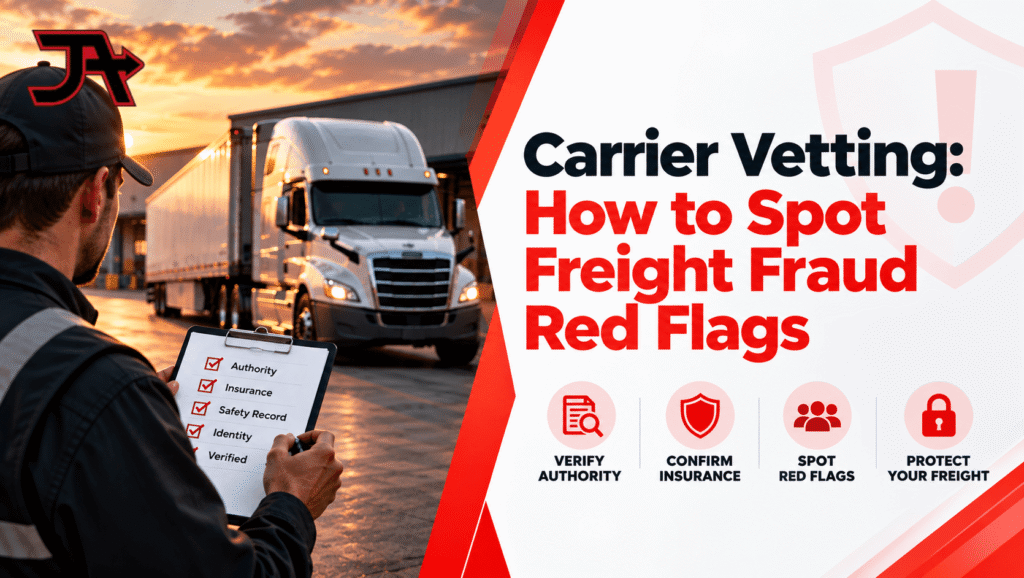
Freight fraud has evolved from opportunistic theft into a coordinated, well-funded criminal enterprise. Highway’s Q1 2026 Freight Fraud Index found that fraud volume reached an all-time high, with carriers that had clean records accounting for roughly half of reported freight fraud.
For a shipper, the fallout can extend well beyond a stolen load. You could face duplicate payment demands, lose the chain-of-custody documentation needed to support a claim, encounter insurance coverage disputes when the carrier at the dock isn’t the carrier identified in the shipment records, or face liability concerns depending on how the carrier was selected. Protecting freight now requires more than a one-time paperwork check. It requires active, continuous, and documented carrier verification.
What Is Carrier Vetting?
Carrier vetting is the process shippers and brokers use to verify that a motor carrier is properly registered, authorized for the transportation it will perform, appropriately insured, and accurately represented before a load is tendered.
Effective vetting combines a records check, including FMCSA authority, operating status, safety information, and insurance, with an identity check that confirms the carrier, driver, truck, and documentation appearing at pickup match the information on file.
Vetting a broker is a different process. It involves confirming that the broker has active FMCSA broker authority and the required financial security, because a broker’s regulatory and fraud risks differ from those associated with operating a motor carrier.
The Five Freight Fraud Schemes Shippers Need to Know in 2026
‣ Double Brokering
Double brokering generally occurs when a carrier accepts a load and then arranges for another carrier to transport it without the required authorization or the shipper or broker’s consent. Depending on the circumstances, this conduct can constitute unauthorized brokerage under federal law, including the requirements established under 49 U.S.C. § 14916.
Double brokering can create serious payment, liability, and cargo-claim complications. If the intermediary collects payment and disappears, the shipper or broker may also face a demand for payment from the legitimate carrier that actually transported the freight.
‣ Carrier Identity Theft and Cloning
Criminals can impersonate legitimate carriers by spoofing email addresses, phone numbers, websites, and other identifying information. They may use a genuine USDOT or MC number belonging to an established carrier to make the fraudulent operation appear legitimate.
Because the underlying FMCSA record may genuinely be clean, a static authority check alone may not expose the fraud. Independent verification of contact information and confirmation that the carrier appearing at pickup matches the carrier that was vetted are therefore critical.
‣ Fictitious and Deceptive Pickups
In a fictitious pickup, criminals arrive at a facility using falsified documentation or a stolen carrier identity and collect the freight before anyone realizes the shipment has been diverted.
Overhaul’s Q1 2026 Cargo Theft Report found that deceptive pickup schemes increased 31% year over year, with nearly half of those incidents occurring in California. The trend highlights the importance of verifying the driver, truck, and shipment documentation at the point of pickup.
‣ Compromised Email and Communication-Based Fraud
Fraudsters can compromise dispatcher or broker email accounts to change payment instructions, alter delivery information, or reroute shipments while making the communication appear legitimate.
Highway’s Q2 2026 Freight Fraud Index found that communication-based attacks, including compromised inboxes, spoofed calls, and impersonation, accounted for 50% of classified fraud vectors, up from 42.7% in Q1.
This makes independent verification particularly important whenever payment instructions, pickup details, delivery locations, or other critical shipment information changes unexpectedly.
‣ Change-of-Ownership Fraud
Change-of-ownership fraud occurs when criminals acquire or take control of an existing carrier authority and use its established operating history to appear legitimate.
Highway’s Q1 2026 Freight Fraud Index recorded a 169.6% year-over-year increase in change-of-ownership reports. The scheme can be difficult to identify because the underlying authority may have a legitimate operating history even though control of the business has changed.
Carrier Red Flags Every Shipper Should Watch For
No single red flag proves that a carrier is fraudulent. However, combinations of the following indicators warrant additional verification:
- Newly established or recently reactivated authority: A carrier becomes active after a long period of inactivity or has limited operating history.
- Mismatched contact information: Email addresses, phone numbers, physical addresses, or domains don’t align with independently verified carrier information.
- Unverified insurance information: Coverage cannot be independently confirmed, appears to be changing unexpectedly, or doesn’t appear appropriate for the shipment.
- Unusually low rates: A rate is significantly below what would normally be expected for the lane and shipment.
- Urgency or pressure: Someone insists that verification be skipped or that freight be released before documentation is finalized.
- Last-minute payment changes: Remittance or banking instructions are changed unexpectedly through email or another unverified communication channel.
- Resistance to tracking: The carrier objects to standard tracking or monitoring requirements without a reasonable explanation.
- Pickup inconsistencies: The truck, driver, license plate, company name, or paperwork at the dock doesn’t match the information provided during booking.
Step-by-Step: How to Vet a Carrier Before You Tender a Load
‣ Step 1: Collect Essential Carrier Data
Before checking the carrier, gather its legal name, DBA, USDOT number, MC/MX number where applicable, physical address, and dispatcher contact information from the booking or tender documentation.
‣ Step 2: Verify the Carrier Through FMCSA SAFER
Search the carrier’s USDOT or MC/MX number in the FMCSA SAFER Company Snapshot. Review the carrier’s identity, operating status, authority information, safety rating, inspection history, out-of-service information, and available crash data.
Don’t treat a clean record as proof that the carrier is legitimate. Identity theft and change-of-ownership schemes can involve legitimate FMCSA records.
‣ Step 3: Verify Contact Information Independently
Contact the carrier using a phone number or other contact information obtained independently from the booking communication.
For example, compare the contact information provided during tendering against information associated with the carrier’s FMCSA record and legitimate company website. Avoid relying solely on a phone number or email address contained in an unexpected load confirmation.
‣ Step 4: Validate Insurance Coverage
Review the carrier’s applicable insurance information using FMCSA’s current registration and insurance systems, and independently confirm coverage with the insurer when appropriate.
Don’t rely solely on a certificate of insurance. Confirm that the applicable coverage is active and appropriate for the carrier’s operation, commodity, and shipment requirements.
‣ Step 5: Check for Ownership and History Changes
Look for recent changes in ownership, operating status, company name, address, contact information, or other material carrier details.
A legitimate carrier can change ownership or business information, so a change isn’t automatically evidence of fraud. However, significant recent changes should trigger additional verification before a high-value load is tendered.
‣ Step 6: Document the Vetting Decision
Maintain a record of what was checked, when it was checked, and which sources were used.
Your documentation might include:
- FMCSA/SAFER records
- Insurance verification
- Contact verification
- Ownership or company-history checks
- Call logs
- Email correspondence
- Verification notes
- The person who performed the review
A documented process creates an audit trail if the carrier’s status or identity is later questioned.
‣ Step 7: Run a Dock-Check Protocol at Pickup
Before releasing freight, verify that the truck, license plate, driver identification, carrier name, and shipment paperwork correspond with the carrier information that was vetted.
Any unexplained discrepancy should trigger a verification hold until the carrier’s identity can be confirmed.
‣ Step 8: Continuously Re-Verify Active Carriers
Carrier vetting shouldn’t end when a carrier is added to your system.
Recheck relevant authority, insurance, ownership, and identity information periodically and before higher-risk shipments. A carrier’s operating status, ownership, contacts, or other critical information can change after onboarding.
How to Verify a Carrier's FMCSA Authority and Insurance
Start with the FMCSA SAFER Company Snapshot to verify the carrier’s identity, USDOT status, operating authority, inspection history, crash information, and safety rating. SAFER supports searches using a USDOT number, MC/MX number, or company name.
For licensing and insurance information, use FMCSA’s current registration and insurance systems and independently confirm the carrier’s insurance coverage when appropriate. FMCSA transitioned its registration and insurance filing system to Motus in 2026, while the legacy Licensing & Insurance system is currently limited to historical motor-carrier records.
Before tendering a load, verify:
- USDOT status: Confirm the carrier’s status is active.
- Operating authority: Confirm the carrier is authorized for the transportation service being performed.
- Safety information: Review available inspection, out-of-service, crash, and safety-rating information for significant concerns.
- Insurance: Confirm applicable coverage is active and appropriate for the carrier’s operation, commodity, and shipment.
- Identity: Make sure the contact information and company identity used for the booking match independently verified information.
What to Do If You Suspect Carrier Fraud
If a carrier resists standard verification, creates unusual urgency, or asks you to skip a verification step, pause the dispatch and independently verify the situation before releasing freight.
- If the freight has already left the dock: Contact the legitimate carrier or other relevant parties immediately to determine whether they actually accepted the shipment. Notify the delivery facility or consignee when appropriate, and preserve all relevant documentation, including emails, email headers, bills of lading, rate confirmations, photographs, driver information, truck information, and license-plate details.
- Report the Incident: Depending on the circumstances, relevant reporting channels may include:
- FMCSA’s National Consumer Complaint Database
- FBI’s Internet Crime Complaint Center (IC3) when applicable, particularly when financial fraud is involved
- TIA’s Watchdog program when a TIA member broker is involved
- Document the Incident Internally: Record the incident against the carrier’s USDOT and MC/MX number, along with the relevant company and contact information. This helps prevent the same identity from being inadvertently approved again if the fraudulent party attempts to operate under another company name or uses the same identifying information.
How J&A Helps Protect Customer Freight
At J&A Transportation, carrier vetting combines technology-enabled verification with human oversight. Our process uses carrier data, identity checks, authority and insurance verification, and other technology-driven signals to identify potential risks before freight is tendered.
Technology is only one part of the process. Our team also performs human verification when a carrier, shipment, or communication raises additional questions. This combination helps us identify inconsistencies that a static database check may not catch and provides an additional layer of protection for customer freight.
By combining automated tools with experienced human review, J&A works to verify that the carrier selected for a shipment is the carrier that actually arrives at the pickup location, helping reduce exposure to identity theft, double brokering, deceptive pickups, and other forms of freight fraud.
Frequently Asked Questions :
Vetting is the verification process used to determine whether a carrier is legitimate, properly authorized, appropriately insured, and suitable for the intended shipment.
Onboarding is the administrative process of adding the carrier to your transportation network, which may include collecting W-9 information, entering payment details, establishing terms, and completing internal documentation.
In practice, the two processes often overlap, but onboarding shouldn't replace independent carrier verification.
Yes. Carrier identity theft and change-of-ownership schemes can involve legitimate, active authorities.
That's why checking an MC or USDOT number is only one part of carrier verification. The company identity, contact information, ownership history, insurance, and the carrier actually appearing at pickup should also be verified.
Unauthorized brokerage can violate federal registration requirements. Under 49 U.S.C. § 14916, a person may not provide interstate brokerage services without the required registration and financial security.
Whether a particular transaction constitutes unlawful double brokering depends on the facts and circumstances.
Liability depends on the facts, contracts, applicable law, and the degree of control exercised by the parties.
A shipper that uses an independent broker may have a different legal risk profile from a shipper that selects and directly controls a carrier. Questions involving negligent selection, agency, and transportation contracts are highly fact-specific and should be reviewed with qualified transportation counsel when necessary.
Start with the FMCSA SAFER Company Snapshot and search by the carrier's USDOT or MC/MX number. Review its operating status, authority information, identity details, safety information, inspection history, and available crash data.
Remember that an active authority doesn't by itself prove that the person contacting you is actually the carrier associated with that authority. Independent identity verification remains essential.
DISCLAIMER:
The information provided in this article is for general informational and educational purposes only. It is not intended to constitute legal, regulatory, insurance, or professional advice. Transportation laws, regulations, contractual obligations, and insurance requirements can vary depending on the circumstances and may change over time. Readers should consult qualified legal, insurance, or transportation professionals regarding their specific situation.